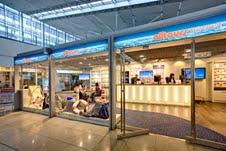


The International Air Transport Association (IATA) unveiled the first mock-up of a Checkpoint of the Future, designed to enhance security while reducing queues and intrusive searches at airports, using intelligence-driven risk-based measures.
Singapore – IATA’s Checkpoint of the Future is being shown to delegates attending the Association’s 67th Annual General Meeting (AGM) and World Air Transport Summit, in Singapore.
“We spend $7.4 billion a year to keep aviation secure. But our passengers only see hassle. Passengers should be able to get from curb to boarding gate with dignity. That means without stopping, stripping or unpacking, and certainly not groping. That is the mission for the Checkpoint of the Future. We must make coordinated investments for civilized flying,” said Giovanni Bisignani, IATA’s Director General and CEO.
The main concepts of the Checkpoint are (1) strengthened security by focusing resources where risk is greatest, (2) supporting this risk-based approach by integrating passenger information into the checkpoint process, and (3) maximizing throughput for the vast majority of travelers who are deemed to be low risk with no compromise on security levels.
“Today’s checkpoint was designed four decades ago to stop hijackers carrying metal weapons. Since then, we have grafted on more complex procedures to meet emerging threats. We are more secure, but it is time to rethink everything. We need a process that responds to today’s threat. It must amalgamate intelligence based on passenger information and new technology. That means moving from a system that looks for bad objects, to one that can find bad people,” said Bisignani.
How does it work?
The Checkpoint of the Future ends the one-size-fits-all concept for security. Passengers approaching the checkpoint will be directed to one of three lanes: ‘known traveler’, ‘normal’, and ‘enhanced security’. The determination will be based on a biometric identifier in the passport or other travel document that triggers the results of a risk assessment conducted by government before the passenger arrives at the airport.
The three security lanes will have technology to check passengers according to risk. “Known travelers” who have registered and completed background checks with government authorities will have expedited access. “Normal screening” would be for the majority of travelers. And those passengers for whom less information is available, who are randomly selected or who are deemed to be an “Elevated risk” would have an additional level of screening.
Screening technology is being developed that will allow passengers to walk through the checkpoint without having to remove clothes or unpack their belongings. Moreover, it is envisioned that the security process could be combined with outbound customs and immigration procedures, further streamlining the passenger experience.
Next Steps
Through the International Civil Aviation Organization (ICAO), 19 governments, including the United States, are working to define standards for a Checkpoint of the Future. IATA is also coordinating closely with the US Department of Homeland Security’s Checkpoint of Tomorrow program which has similar goals.
“We have the ability to move to the biometric scanning and three-lane concept right now. And while some of the technology still needs to be developed, even by just re-purposing what we have today, we could see major changes in two or three years time,” said Bisignani.
Picture: IATA